What is the DAT System?
How Does the “Situation–Meaning–Response” Model Developed by Hakan Mengüç Work?
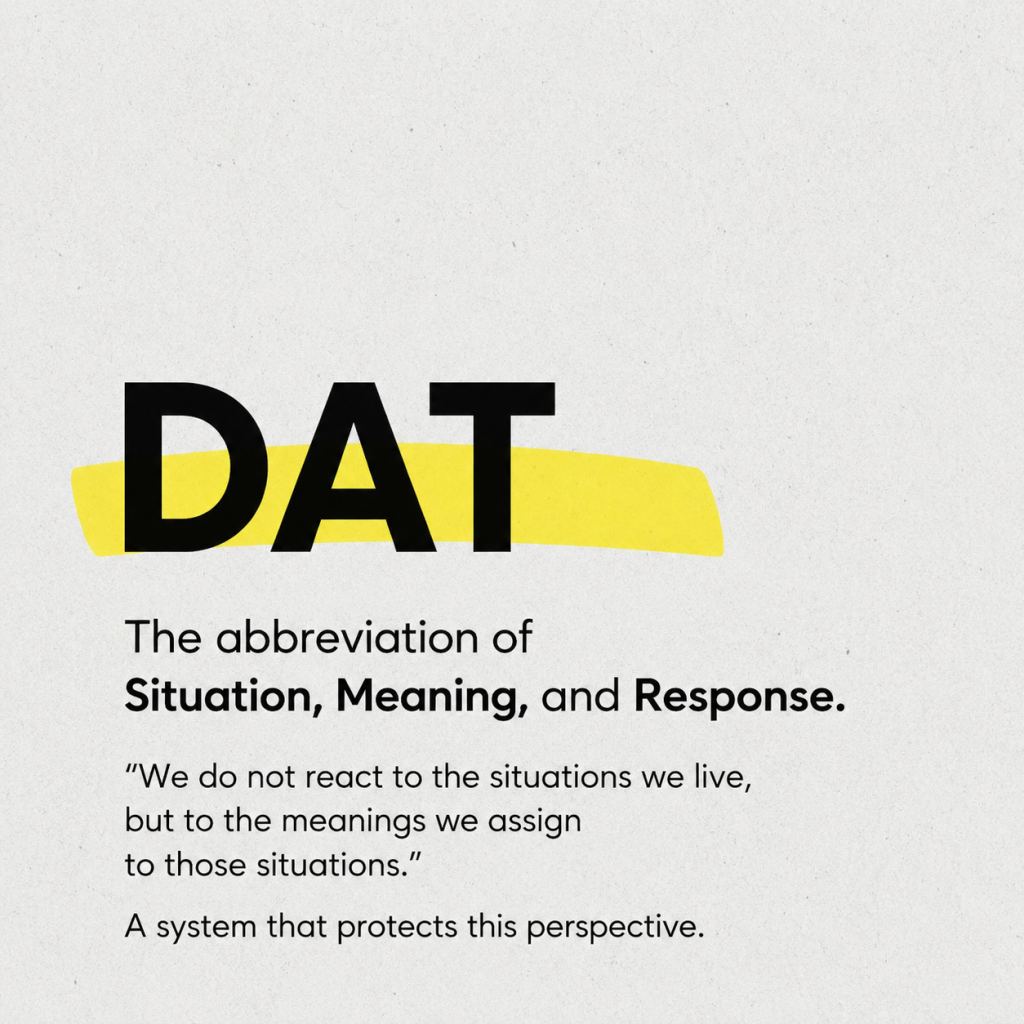
Why do people react differently to the same event? Why can some stay calm during the most difficult times while others experience intense anxiety over minor incidents? The answer often lies not in the events themselves, but in the meaning we assign to them.
The DAT System, developed by Hakan Mengüç, is a practical and applicable mental model designed to help people understand their own emotions and behaviors.
In this article, we will examine in detail what the DAT System is, how it works, when it is used, and why it is effective.
What is the DAT System?
The DAT System is an awareness model that helps individuals evaluate their experiences more healthily. The acronym DAT is derived from the Turkish initials of three concepts:
- D (Durum):Situation
- A (Anlam):Meaning
- T (Tepki):Response
The core idea of the model is simple: It is not the events themselves that affect us, but the meaning we assign to them.
In other words, the mental process that flows as:
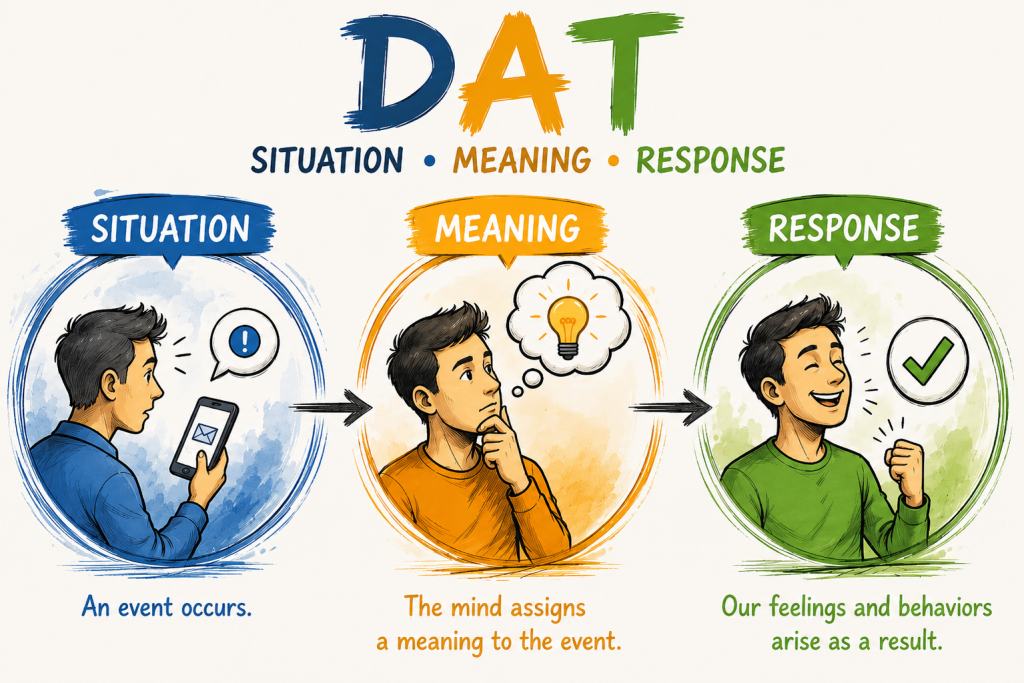
Situation → Meaning → Response
constitutes the majority of the emotions we experience.
The Basic Logic of the DAT System
- An event occurs in life.
- Our mind interprets this event within seconds.
- Emotions and behaviors emerge based on this interpretation.
Sequence:Situation → Meaning → Emotion → Behavior
Most people try to change only the final step. They want to be less anxious, less angry, happier, or more motivated. However, according to the DAT System, true change begins not by changing the response, but by changing the meaning.
How Does the DAT System Work?
The model consists of three simple steps:
1. Situation
The situation is any event happening in the external world (e.g., your phone not ringing, your boss calling you to their office, a friend replying late to a message, rain). The situation is objective; it is not yet “good” or “bad.”
2. Meaning
Meaning is the interpretation your mind assigns to the event. This is where emotions are created. For example, if your boss calls you:
- Interpretation A: “I must have made a mistake.” → Result:Anxiety, fear, stress.
- Interpretation B: “They want to talk about a new project.” → Result:Excitement, curiosity, motivation.The boss and the room are the same; the only thing that changed is the meaning.
3. Response
These are the feelings and behaviors that arise as a result of the meaning we assigned. Negative meanings lead to anxiety or avoidance, while realistic or positive meanings lead to calmness, patience, and a solution-oriented mindset.
Example of the DAT System
A friend hasn’t replied to your message for three hours.
- Situation: No reply.
- Meaning 1:“They don’t value me.” → Response:Sadness, resentment, anger.
- Meaning 2:“They are probably in a meeting.” → Response:Calmness, patience, understanding.
The message, the phone, and the time are identical. Only the meaning has changed.
Why Is the DAT System Effective?
Explaining Anxiety
Many people notice their heart racing and think, “Something bad is happening to me,” which increases fear. However, when the same person exercises or climbs stairs, their heart also races, yet they don’t feel afraid. Why? Because the meaning is different: one is “my body is working,” the other is “I am in danger.”
The “Hose vs. Snake” Analogy
If you mistake a garden hose on the ground for a snake in the dark, your body goes into alarm mode. Once you turn on the light and realize it is just a hose, your fear instantly vanishes. The hose didn’t change; your meaningof the object did.
Changing Thoughts
Instead of fighting thoughts (which often makes them stronger, like being told “don’t think of a red elephant”), the DAT System focuses on the meaning. By changing the meaning, thoughts naturally evolve over time.
Relationship with Sufism
The DAT System establishes a link between modern psychological observations and the ancient principles of Sufism. In Sufism, peace is found not by controlling the outer world, but by managing the inner world. You cannot stop the storm, but you can turn the rudder. You cannot stop the rain, but you can open an umbrella.
How Can You Apply the DAT System in Daily Life?
Ask yourself these three questions:
- What is the situation?(Define the event without interpretation.)
- What meaning am I assigning to this? (Notice the story your mind is writing.)
- What other meanings could be possible?(This opens the door to a new perspective.)
Frequently Asked Questions (FAQ)
- What is the DAT System? It is a “Situation-Meaning-Response” model developed by Hakan Mengüç to explain how the meaning assigned to events shapes emotions.
- Is it a form of therapy? No. It is an educational and personal development model based on awareness and cognitive evaluation, not a medical or clinical diagnosis/treatment method.
- What is its purpose? It aims not to deny reality or force “positive thinking,” but to recognize automatic interpretations, see alternative perspectives, and manage emotional responses more consciously.
Hakan Mengüç is an author whose books have been translated into more than 30 languages, an academic, a speaker, and a musician. He is widely recognized for his books and seminars focusing particularly on Sufism, positive psychology, and Eastern philosophy.
What is Hakan Mengüç’s Educational and Academic Background?
- Current Role: He serves as the President of the Sufi Academy, which was established under the umbrella of Girne American University.
- Academic Work: Within the academy, he delivers lectures and training programs on Sufi philosophy, Eastern mysticism, and positive psychology.
What is Hakan Mengüç’s Musical Career and Background?
- Instrument: He started playing the ney (a traditional Sufi reed flute) at a very young age. Also he plays piano
- Education and Works: He received formal conservatory training as a ney player (neyzen) and has composed more than 50 musical pieces.
What are the Best-Selling Books by Hakan Mengüç?
Hakan Mengüç is the author of several best-selling books in the fields of philosophy, positive psychology, and personal development, including:
- “Hiçbir Karşılaşma Tesadüf Değildir” (No Encounter is a Coincidence)
- “Kalbin Temizse Hikayen Mutlu Biter” (If Your Heart is Pure, Your Story Ends Happily)
- “Ben Ney’im” (I am the Ney / Who am I?)
What is Hakan Mengüç’s Philosophy and Teaching?
In his teachings, Hakan Mengüç synthesizes the Sufi philosophy of Mevlana Celaleddin-i Rumi and Eastern mysticism with modern positive psychology methods, translating ancient wisdom into practical daily life guidance.
The Most Famous Quote by Hakan Mengüç: “No encounter is a coincidence; there is a reason for every person entering our lives.”
