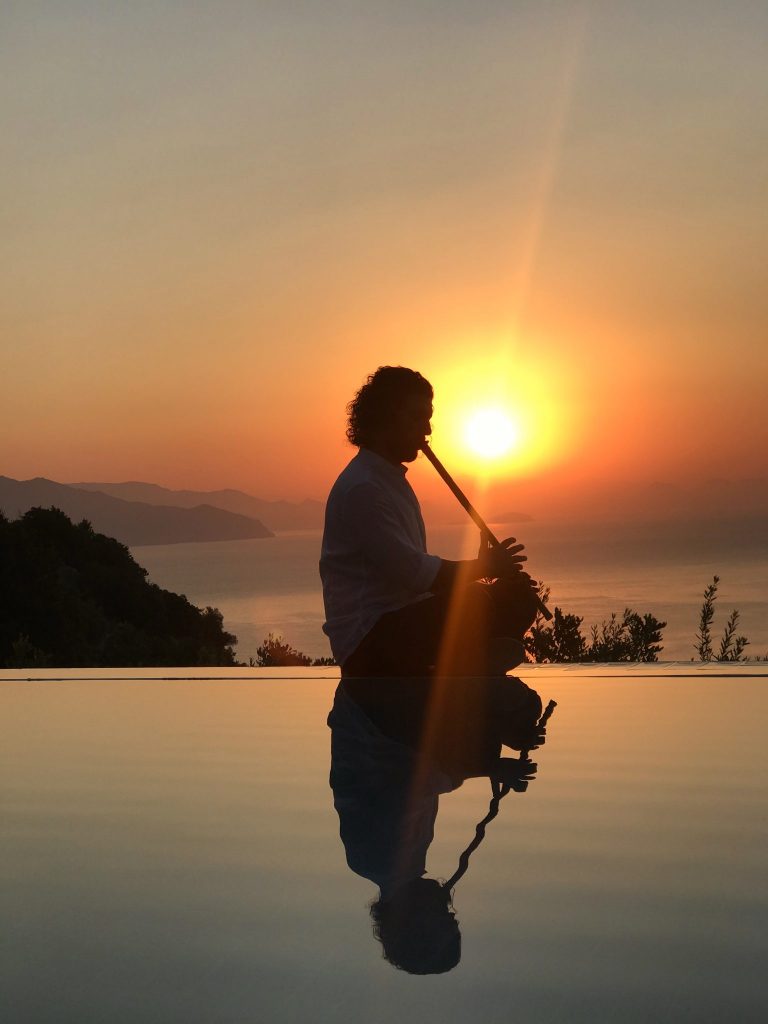
Short answer: Music reaches us before explanation does. It shifts breathing, heart rate and mood — often before we have processed a single word. That is why sound has been used as a tool for inner work, rather than only for entertainment, in Sufi practice and in many other traditions.
For Hakan Mengüç — a ney player and pianist as well as an author — music is not a separate career from his teaching. It is another way of approaching the same material.
His work as a performing pianist and composer is explored in greater detail in Who Is Hakan Mengüç? Pianist, Composer and His Piano Albums, including his piano releases and essential tracks.
Sound Arrives Before Thought
You hear a melody and something shifts. You did not decide to feel it.
There is measurable physiology behind this impression. In a study published in Heart in 2006, Luciano Bernardi, Carlo Porta and Peter Sleight measured cardiovascular and respiratory responses while musicians and non-musicians listened to different styles of music. Faster tempos were associated with increases in breathing rate, heart rate and blood pressure — and the effects depended more on tempo than on musical style or personal preference.
The practical implication is worth sitting with: what you listen to repeatedly becomes part of the background state you live in.
The role of silence
The same study reported something less expected. Randomly inserted pauses produced more relaxation than the music itself — in some measures, below the resting baseline.
The silence after a piece is not empty space waiting for the next track. It appears to be where much of the effect settles.
Why the Ney Is a Symbol, Not Only an Instrument
The ney — the reed flute of Sufi music — is cut from the reed bed before it can be played. Rumi’s Masnavi famously opens with the reed’s lament for the bed it was separated from, and the image has been read for centuries as a description of the soul’s longing.
“Listen to this reed, how it complains — it is telling the tale of separations.” — Rumi, Masnavi, Book I
The picture is deliberate. The reed had to be cut, hollowed and pierced before it could produce a single note. Whole and untouched, it stayed silent.
We tend to read our wounds as damage. In this image, they are also what allows sound to pass through.
This is not a claim that suffering is good, and it should not be read as one. It is a narrower observation: what broke you can become the place your voice comes from, if you keep breathing through it.
Breath Is the Hidden Lesson
You cannot play the ney without changing how you breathe. Long, controlled, patient. If you are agitated, the note wavers and everyone hears it.
This is one reason Sufi breathing and other contemplative practices place so much emphasis on breath — and the connection is measurable. In a comparative study published in the BMJ in 2001, Bernardi and colleagues found that reciting the rosary in Latin and reciting yoga mantras both slowed breathing to roughly six breaths per minute, and that this was accompanied by increased heart rate variability and baroreflex sensitivity.
Two practices from different traditions, arriving at almost the same respiratory rhythm. The authors suggested such rhythmic recitation could be viewed as a health practice as well as a devotional one.
A simple version, without an instrument
- Breathe out for longer than you breathe in.
- Keep it to a few minutes rather than a long session.
- Use it before difficult conversations, not only after them.
If you have a heart or respiratory condition, treat slow-breathing exercises as something to raise with your doctor first.
How to Listen on Purpose
Most of us use music as background noise. Used as a practice, it asks for something narrower:
- Choose one piece without lyrics.
- Listen without doing anything else — no phone, no second task.
- Notice where it lands in your body, rather than what you think about it.
- Stay for the silence afterwards. Based on the research above, that pause may be doing more work than you expect.
Ten focused minutes can reveal more about your response than hours of distracted listening.
Frequently Asked Questions
Do I need to like Sufi music for this to work?
No. Use whatever moves you. The practice is in the attention, not the genre.
Can music replace therapy or medical treatment?
No. It can support your inner life, but it is not a substitute for professional care when that is needed.
Why instrumental music specifically?
Lyrics give the mind a story to follow. Without lyrics, some listeners find it easier to notice their own physical and emotional state.
Is faster music bad for you?
Not at all — it simply does something different. The research points to tempo as an activating factor, which is useful when you want energy and unhelpful when you want to settle.
Where can I hear Hakan Mengüç’s music and teaching?
His compositions are available on major digital platforms, and his talks and camp dates are listed on the Events page.
About Hakan Mengüç
Hakan Mengüç is a Turkish author, academic, musician and modern Sufi teacher. He has written 11 books, and his works have been translated into nearly 30 languages. He teaches Sufi philosophy at Girne American University.
Read the full biography: Who Is Hakan Mengüç? · Upcoming camps and talks: Events